The room was quiet at first.
A few patients sat with folded hands. Others looked down at the floor. Some seemed anxious. Some seemed tired. Conversation was limited.
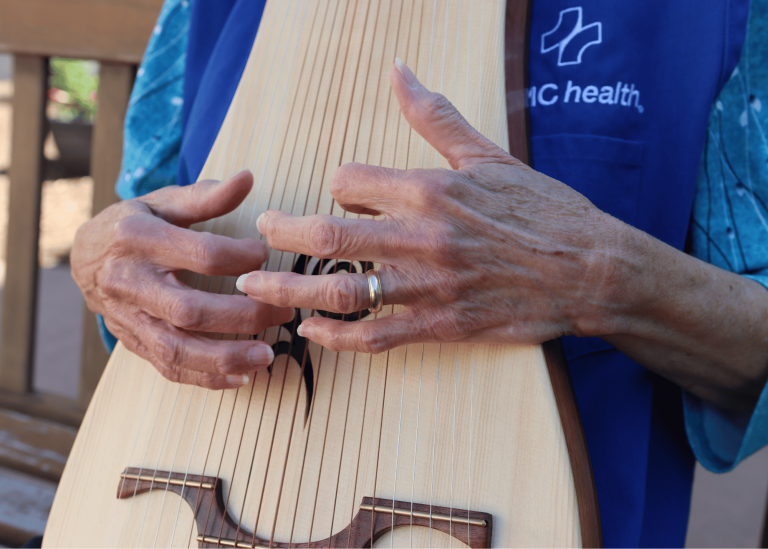
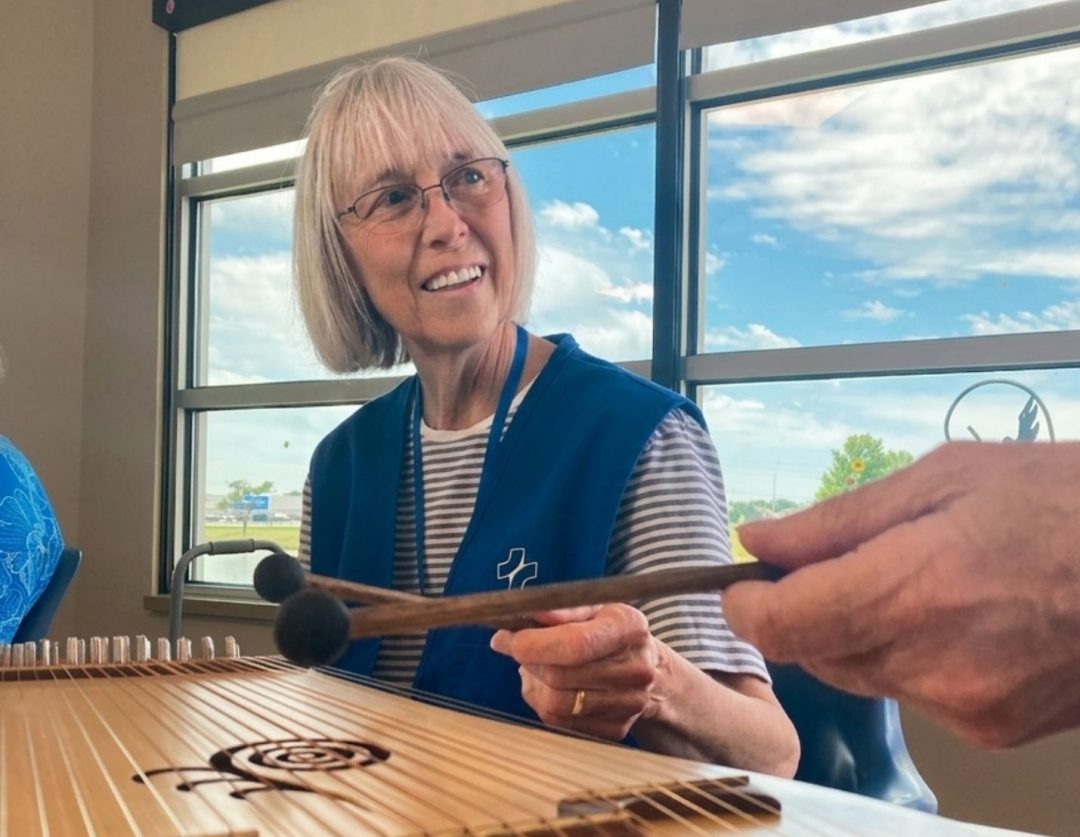
Then, Cheryl plucked the first string on her harp.
The sound floated softly through the Senior Behavioral Health Center (SBHC) at NMC Health. Heads slowly lifted. Faces softened. One patient silently gasped, looked around, then smiled.
Within minutes, the room had changed.
Patients who had been silent started talking with one another. Some shared memories from childhood. Others described places the music seemed to carry them. As Cheryl played, a social worker gently asked the group where the music took them. Together, the group rode horses through cherry blossoms in Japan. They watched the sun rise over the Flint Hills, and they witnessed squirrels waking up after a restful night. For a little while, the worries in the room seemed lighter.
That is the gift Cheryl brings each week.
An unexpected beginning
What makes Cheryl’s story remarkable is that she never planned to become a harp player.
In fact, a little over a year ago, she had never played one at all.
It started with a visit to a local thrift shop, where Cheryl spotted an autoharp sitting among the donated items. The instrument was inexpensive, worn down, and needed repairs. Most people probably would have passed it by.
But Cheryl had a friend who played the harp, and something about the instrument caught her attention.
“She said, ‘Get it now,’” Cheryl recalled.
So, she did.
Not knowing how to repair it herself, Cheryl asked her friend if she knew anyone who could help. That led her to a craftsman who repaired and built harps.
At the time, Cheryl was already volunteering with hospice patients in Wichita. As she talked with the gentleman and saw the instruments he created, something clicked deep inside her.
“I knew this was meant to be,” Cheryl said.
Cheryl’s harp began to be built in November 2024. By March 2025, it was complete. Looking back now, Cheryl feels like the harp somehow found its way to her.
Bringing music into the hospital
Cheryl first came to NMC Health through the Comfort Companions volunteer program. The program pairs trained volunteers with patients who may be nearing the end of life, offering companionship and support during difficult moments. She still serves in that role today and brings the harp with her to patient visits.
“Often I won’t get it out right away,” she explained. “I’ll just set it to the side and see if they’re interested.”
If patients seem open to it, Cheryl begins to play. The response is often immediate.
Soon, others encouraged her to bring the harp into the SBHC as well. NMC Health’s senior behavioral health unit provides specialized care for Alzheimer’s and dementia patients. Now she visits regularly, often once a week. Her visits have become something both patients and staff look forward to.
Watching anxiety fade
Cheryl has learned to notice the subtle changes that happen when the music begins.
“At first they’re like, ‘What is this?’” she said with a smile. Then little by little, people begin to relax.
“You’ll notice it in their faces,” she explained. “They’ll say they feel relaxed.”
For patients experiencing anxiety, depression, or emotional distress, the music seems to create a calming space where they can breathe a little easier.
“You’ll see them quit some of the anxious behavior,” Cheryl said.
But Cheryl does not believe the healing comes from her personally.
“It’s the music,” she said. “It’s hearing sounds that all sound good together.”
Cheryl makes the harp approachable for everyone in the room. Before inviting patients to try it, she explains that all the notes on the harp sound good together, meaning there are no wrong notes to play.
“Anyone can play the harp and it will sound good,” she tells the patients.
At first many patients hesitate. Some smile nervously or wave off the idea. But with a little encouragement, many eventually reach out and pluck the strings themselves.
Soon, patients who may not normally interact begin speaking to one another. Memories surface. Stories are shared.
“That’s one of the wonderful aspects of the harp,” she said.
The experience becomes less about listening and more about sharing something together: creating music together, side by side, one gentle note at a time.
Sometimes Cheryl reminds patients to hold onto the calm they feel while listening. “I’ll say, ‘Remember how you feel right now and come back to that place.’”
Courageous people
What continues to draw Cheryl back to the SBHC is the patients themselves.
“I see a lot of courageous people,” she said with tears in her eyes. “They’re still showing up. It’s amazing.”
Though she does not know every patient’s story, Cheryl believes many of them have faced challenges others cannot fully understand.
“They’re often very sensitive people,” she explained. “That sensitivity can be a gift, but it can also make life harder sometimes.”
Her experiences in the unit have deepened her understanding of mental health and aging.
“It helps me see there are things we can do to help ourselves through hard times,” she said.
For some people, that may be music. For others, it may be painting, clay work, gardening, or another creative outlet.
“Not everyone will connect with the harp,” Cheryl said. “But there will be something.”
Moments that stay with her
Nearly every visit leaves Cheryl with a memory she carries home.
“There’s almost always something memorable,” she said.
To her, music reaches places words sometimes cannot.
“It has a healing quality,” she said. “A soothing, healing, expressive quality.” She pauses for a moment before adding: “It’s mysterious how it works.”
A place to share your gifts
Cheryl says volunteering at NMC Health has become a meaningful part of her life.
“I just feel like it’s a really good place to volunteer,” she said.
She especially values the training and support provided through the Comfort Companions program, as well as the relationships she has built with fellow volunteers and staff.
And she hopes her story encourages others to share their own gifts too.
“People may realize they have talents they could bring into this environment,” she said. “Art, clay, music — there are so many things.”
She also has deep appreciation for the SBHC staff members who care for patients every day: “They are dedicated, patient, and compassionate. Just the folks you would want caring for your own family.”
Each week, Cheryl walks into the unit carrying her harp.
And each week, for a little while, the music helps patients remember beautiful places, treasured memories, and peaceful moments that still live inside them.